A proprietor in Abeokuta opened her fee ledger for me.
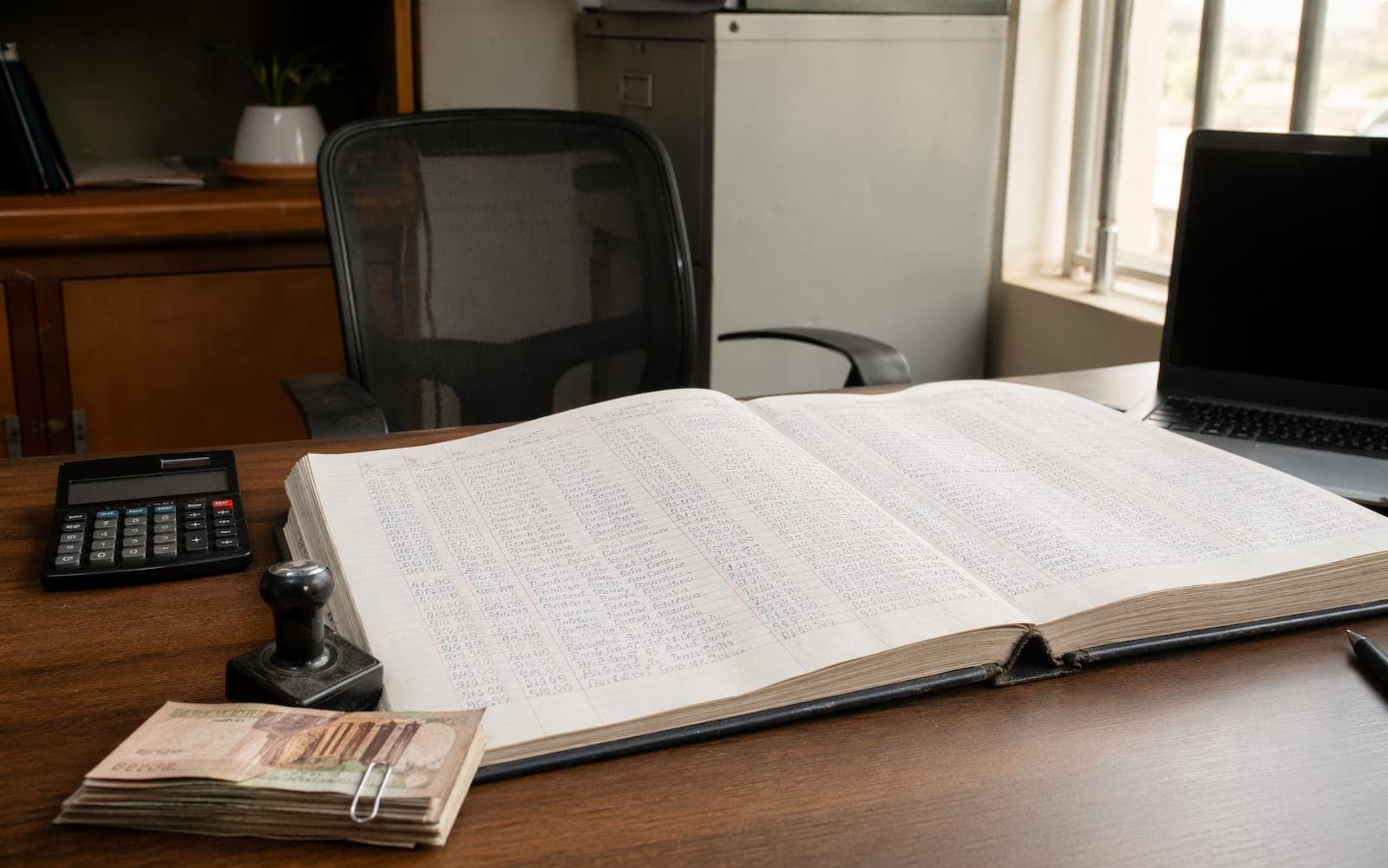
The ledger was a hardcover notebook, A4 size, about two inches thick. Each page had a parent's name at the top, written in her bursar's steady handwriting, followed by columns for term, amount due, amount paid, and a balance that was sometimes written in pencil and sometimes in red ink. Some pages had sticky notes attached with dates on them. Some had small arrows drawn between cells where a payment had been retroactively applied to the wrong term.
The proprietor flipped to a page marked in red. "This parent has owed us since first term last year," she said. "He promised to pay in installments. He paid one. Then he went quiet."
She flipped to another page. "This one. Two terms behind. She said her husband would send the money from abroad. We have not heard from her in six weeks."
Another page. "This one says she paid. Her receipt is in the file. But my bursar did not record it in the ledger. I had to go check the bank statement to confirm."
She closed the notebook. "I calculated last week. We are owed about four point two million naira across three terms. Some of it we may never collect. I do not know how much of it we can collect because I do not know how many of these parents are actively avoiding us and how many of them are just waiting to be asked."
Her school had about 220 students. The uncollected fees represented almost a full term of tuition from eighty percent of them, lost not because eighty percent of parents had not paid but because a smaller number of parents were carrying balances that had accumulated over a year and a half of incomplete tracking.
This post is about how her school was losing that money, and how we rebuilt her fee tracking in one afternoon so she could actually see what was owed, by whom, and what to do about it.
How the ₦4.2M happened
The proprietor was not careless. Neither was her bursar. They were both running a system designed for a smaller school, and the system had silently stopped working as the school grew.
The mechanics of the loss were boring and common.
Partial payments were recorded but not tracked forward. A parent would pay half the term's fees. The bursar wrote the payment in the ledger. The balance stayed as a number in the column, but no reminder ever fired to collect it. The parent moved on. The school moved on. The balance sat on the page.
Payments landed in the wrong term. A parent paid for first term late, in the middle of second term. The bursar recorded the payment for second term because that was the term the school was currently in. The first-term balance stayed open on paper. The parent thought they were caught up. The school thought they owed two terms of fees.
Bank transfers were not reconciled. Parents paid by bank transfer more than by cash now. But the bursar's ledger was updated when parents brought in a receipt or texted a confirmation. When a parent transferred money and forgot to tell the school, the payment sat in the school's bank account unrecorded. The ledger showed a balance that no longer existed.
No one had a single view. The ledger had one version of the truth. The bank statement had another. The parent's memory had a third. Resolving discrepancies required pulling all three together, which the bursar only had time to do once a term, under pressure, in the last week.
None of these mistakes are unusual. All of them are invisible until you add them up across two hundred parents and eighteen months, and then they are ₦4.2M.
The two-hour rebuild
Here is what we did that afternoon.
Step one: one source of truth. Every parent's fee record moved into a single system. Name, class, term-by-term amount due, term-by-term amount paid, running balance. The ledger came in as the starting point, but the bank statement was used to cross-check every transaction against the ledger for the past two terms. Discrepancies were flagged for follow-up.
This alone reduced the "uncollected" number by about ₦700,000, money that had been paid but never reconciled against the ledger. The school had actually collected ₦700,000 more than it thought.
Step two: separate the buckets. The remaining balance was split into three categories:
- Confirmed defaulters: parents who had explicitly stopped responding or who had made partial payments and disappeared. This bucket held the largest share of the outstanding amount, roughly ₦2.1 million.
- Communication gaps: parents who had never been properly asked, or who had been asked informally and not followed up. Many of these had no idea they owed money or thought their partial payments had cleared the balance. About ₦1.1 million.
- Genuine hardship cases: parents who had communicated that they could not pay on time and had worked out informal agreements that were not documented anywhere. About ₦300,000.
The proprietor now had three different problems instead of one, and three different strategies to solve them.
Step three: immediate actions.
For communication gaps, a polite, specific message went out to each affected parent within 24 hours. "Your child's fee balance for second term is ₦X. Would you like to settle today or arrange an installment?" Over half of these parents paid within a week, once they knew exactly what they owed. This alone recovered about ₦600,000.
For genuine hardship cases, the proprietor met each parent individually, documented the agreement, and scheduled the installment dates in her system. Parents appreciated the formality. Most payments came in on schedule.
For confirmed defaulters, the school sent a formal letter home with the student, followed by a phone call from the proprietor. Parents who still did not respond were asked to come to the school for a meeting. Some parents paid immediately once they realized the school was treating the debt seriously. Others negotiated installment plans on the spot. A handful were told their child's end-of-term report card would be held until the balance was cleared, which is a standard Nigerian private school escalation that almost always works. A small number of genuinely absent parents were eventually referred to the school's lawyer for a formal demand, though the proprietor made that decision sparingly because the goal was to recover the money, not to make enemies of the families.
Over the following three months, the school recovered about ₦2.8 million of the original ₦4.2M. Not all of it. But significantly more than the proprietor had expected, and far more than she would have recovered staying on the old ledger system.
The method, without the story
If you are a Nigerian proprietor reading this and you suspect your own fee tracking has silent losses, here is what to do.
Reconcile the ledger against the bank statement for the last two terms. This is the single highest-leverage action. Every school running on paper has money they have already collected that they have not recorded.
Categorize outstanding balances into defaulters, communication gaps, and hardship cases. Treating all three the same is why schools write off money they could easily recover.
Send specific, respectful messages to the communication-gap parents first. Most of them will pay once they know. This is the quickest recovery.
Document hardship agreements formally. An installment plan that exists only in memory turns into a dispute in three months. An installment plan written down is usually honored.
Move fee tracking off paper and into a system where every payment lands in one view. Not because paper is inherently worse, but because a 220-student school running on paper will have silent losses no matter how careful the bursar is. The math just catches up to you.
What to do next
The fee tracking method above is what SLAET was built around. Parents' balances update in real time as payments come in. Bank reconciliation is one click. Communication gaps surface automatically. The debt schedule generates itself, sorted by how old each balance is and how to prioritize follow-up.
Your Starter account is free forever for schools up to 100 students and covers fee tracking, parent communication, and the reconciliation that makes ₦4.2M losses impossible. For larger schools, our pricing page shows what proper fee management actually costs.
The proprietor in Abeokuta still has some of that ₦4.2M outstanding. She has recovered most of it. She told me, the last time we spoke, that she knows exactly which parents owe what now. She has never said that before.
The money you are owed is worth recovering. The system you need to recover it is worth the afternoon it takes to set up.