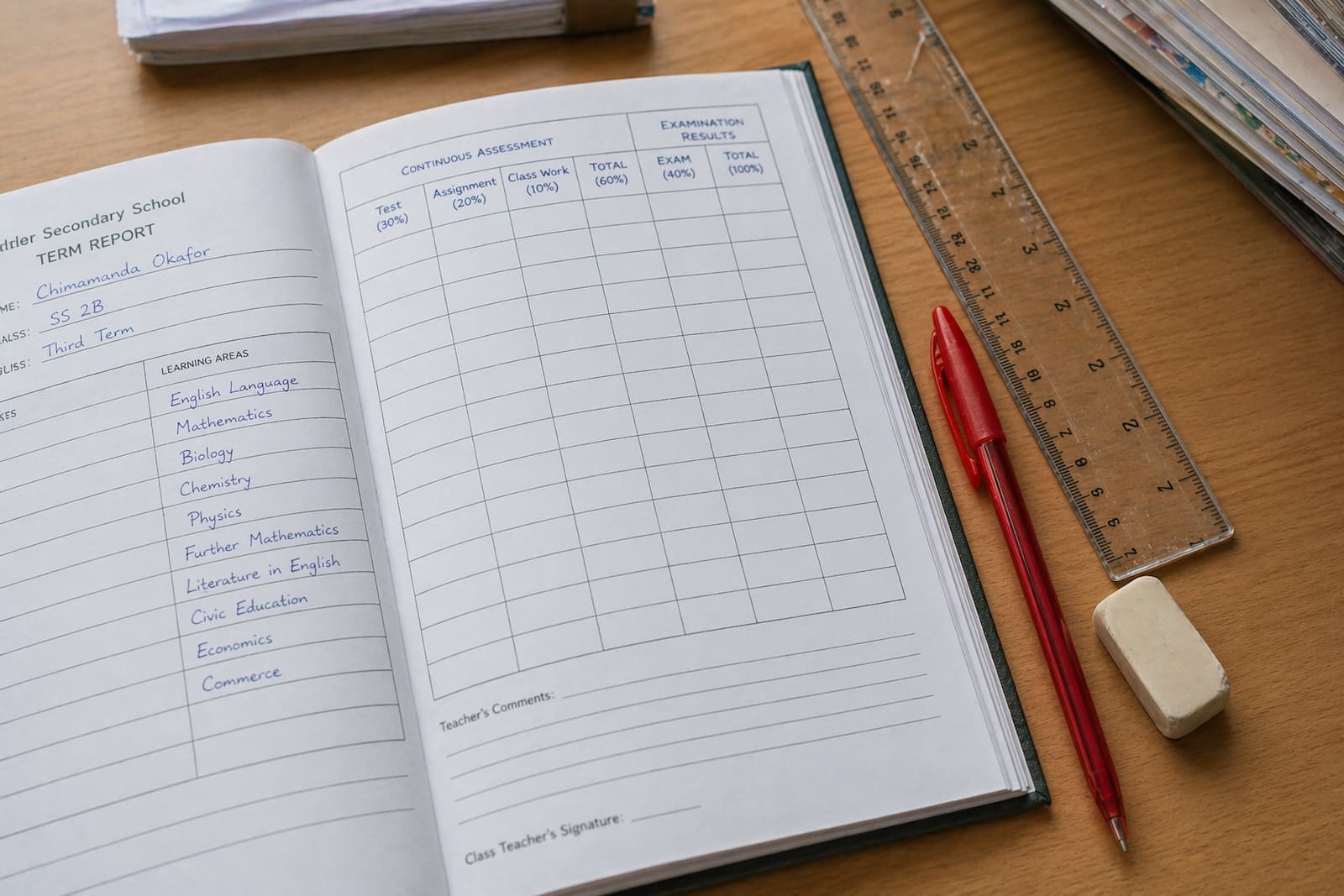
Import a global school management tool into a Nigerian school and the first thing that breaks is grading.
The tool expects a single percentage score per subject. The Nigerian teacher has Continuous Assessment 1, Continuous Assessment 2, and a final exam. Each one is weighted. Each one contributes to a term grade. Each one appears separately on the report card. The term grade then rolls up into a session grade across three terms.
That is not a feature configuration. It is a different system. A foreign tool asking "what's the student's score?" cannot produce a correct Nigerian report card, because Nigerian report cards do not work off single scores.
SLAET was built in Nigeria, for Nigerian schools. Grading was the first system we built, before we built anything else. This post explains how it works, why it works that way, and what it takes to get it right.
How Nigerian schools actually grade
Most Nigerian private and public schools structure each term's grade as follows:
- Continuous Assessment 1 (CA1): a test or assignment taken roughly six weeks into the term. Commonly worth 20 marks.
- Continuous Assessment 2 (CA2): a second test or assignment taken roughly ten to twelve weeks in. Commonly worth 20 marks.
- Final Exam: a comprehensive end-of-term exam covering the full term's content. Commonly worth 60 marks.
Those three numbers sum to 100. The 100 is the student's term grade for that subject. Schools then apply a letter grade band and that letter goes on the report card alongside the numeric score.
The most common Nigerian grade band is:
- A: 75 to 100
- B: 65 to 74
- C: 55 to 64
- D: 45 to 54
- E: 35 to 44
- F: 0 to 34
Some schools use different splits for the weighting. A school might weight CA1 at 15 and CA2 at 15 with the exam at 70. Another might run CA3 and CA4 alongside CA1 and CA2, splitting the continuous-assessment portion into four equal 10-mark pieces plus a 60-mark exam. A few Montessori-style schools use entirely different weighting.
Whatever the split, the underlying structure is the same: term grade equals a weighted sum of several assessments, each of which is entered and tracked separately, each of which appears on the report card, each of which can be commented on.
What foreign software gets wrong
We've watched schools try to use Google Classroom, foreign school platforms, and generic LMS tools. The same three failures show up every time.
The grade model does not match. The tool expects one score per student per subject, usually a percentage between 0 and 100. The Nigerian teacher has to manually calculate CA1 + CA2 + exam, enter the result, and hope she doesn't make a mistake. The tool cannot show CA1 and CA2 and exam separately, because to the tool, they do not exist.
The report card does not match. Nigerian report cards list each subject with columns for CA1, CA2, Exam, Total, Grade, Position in Class, and often Teacher's Remark. They are printed on school letterhead, signed by the class teacher and the proprietor, and given to parents at end of term. No foreign tool produces this layout. Schools end up exporting numbers into Excel and rebuilding the report card by hand every term.
The grading bands do not match. Foreign tools assume A/B/C/D/F with standard American or British cutoffs, usually starting A at 90. Nigerian schools typically start A at 75, use six bands instead of five, and the bands sometimes vary between schools. The tool either cannot configure this at all, or makes it painful.
The result is predictable: teachers stop using the tool and go back to paper and Excel. The school pays for software that nobody uses. The promise of digital grading stays broken.
How SLAET handles term grading
SLAET is built around the structure Nigerian schools actually use. Everything in the grading module assumes CA1 + CA2 + Exam as the default framework, with full flexibility to change weightings and add more assessments per school.
Here is what that looks like in practice.
Default assessment structure. When a school is set up, SLAET assumes 20/20/60. That covers the majority of Nigerian schools out of the box. No configuration needed before a teacher can start entering grades.
Custom weightings per school or per subject. Schools that use 15/15/70 set that in settings once. Schools that use 10/10/10/70 add assessment slots. Schools that weight English differently from Mathematics can set per-subject weightings. The flexibility is there when it is needed, and invisible when it is not.
Separate entry for each assessment. When a teacher opens a class to grade, she sees a table with one row per student and columns for CA1, CA2, and Exam. She enters the raw marks for each, and SLAET calculates the total, the percentage, the letter grade, and the position in class automatically. No manual math.
Grade bands configurable per school. The default is the standard Nigerian band (A=75+, B=65-74, C=55-64, D=45-54, E=35-44, F<35), but every threshold is editable in settings. Schools that run an 80-cut-off for A set that once and it applies everywhere.
Report cards that look like Nigerian report cards. The report card export in SLAET lists each subject with CA1, CA2, Exam, Total, Grade, and Position columns. It includes school letterhead, term and session labels, form teacher's remark, proprietor's signature area, and next term's resumption date. This is the actual layout Nigerian parents recognize. Teachers do not rebuild anything.
Term and session rollup. Each subject's term grade automatically rolls into the session grade across first, second, and third term. Students and parents see the full session view. Cumulative averages are calculated without anybody touching a calculator.
The small details that add up
The difference between software that works in Nigeria and software that doesn't is usually in small places.
Our grading system knows that a late CA can be entered after the fact without breaking a grade that was already shown to parents. It knows that some subjects (like agricultural science or home economics) have practical components that schools score separately. It knows that a teacher grading her class in the staff room after school wants to tab from one student to the next without reaching for a mouse, save as she goes, and see any missing entries highlighted so she doesn't forget anyone.
We did not build these features because we are clever. We built them because we watched Nigerian teachers try to grade classes on foreign tools and hit wall after wall. Every detail in the SLAET grading module exists because a real Nigerian teacher told us it was missing everywhere else.
What comes next
This post stays focused on term grading, because term grading is the foundation. A future Chalkline post will cover how SLAET handles WAEC and NECO grading bands (A1, B2, B3, C4, C5, C6, D7, E8, F9), how external exam results integrate with internal term grades, and how schools preparing students for external exams can track readiness.
If you run a Nigerian school and grading has been your biggest admin headache, start a free SLAET account and see how it feels when the software actually understands your grading model. Your Starter account gives you full grading for up to 100 students, forever free.
If you want to see the full platform including every module, view our features page.